LISA is a user-friendly finite element analysis package with an integrated modeler, multi-threaded solver and graphical post-processor.
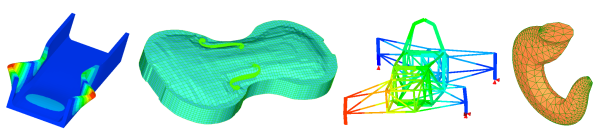
It has a broad range of functionality to test the design integrity of custom machines/devices, structures, heat exchangers, HVAC, etc.
LISA has an easy to use interface, is backed by free technical support and has an extensively documented user manual.
Newcomers to the FE method will find LISA an indispensible tool, which is why universities in the U.S, U.K, Canada, Italy, Netherlands, Spain, Poland & Japan use LISA for their introductory courses, despite having ANSYS seats.
LISA is priced to be affordable to individuals and not just companies.
Models can incorporate solids, shells, membranes, space frames, pin-jointed
trusses and anisotropic materials including laminated composites. Pressures,
point forces, thermal expansion, gravity, centrifugal force and fixed displacements
can be applied. Nodes can be constrained on inclined planes and coupled to
define rigid connections. Cyclic and linear periodic symmetry can easily be
exploited to simplify repetitive structures. Various stresses are computed
to predict failure locations and safety factors.
Finds the natural frequencies of a structure and its vibrating mode
shapes. Supports membranes, solids and space frames. Complex
structures having rotational periodicity, such as turbine wheels can
be efficiently solved by exploiting cyclic symmetry.
The behaviour of structures subject to time-varying loads can be extremely
difficult to estimate without computer simulation. LISA generates an animation
of the induced vibrations and changing stresses. Both modal and explicit time
stepping can be used.
Time history of heating and cooling can be computed using effects such as
convection, radiation, constant heat sources and temperature dependant material
properties. Fin elements can easily model heatsinks, wires and beams with the
aid of predefined or custom cross-sections. Steady state temperature and heat
flux distributions can be solved more quickly.
LISA can model 3D inviscid flows, general 2D flow according to the Navier-Stokes
equations, seepage through porous materials, hydrodynamic lubrication of bearings
and Non-Newtonian fluids such as plastic melt and food. It can also find seiche
or sloshing modes of liquids in tanks and enclosed basins.
Linear eigenvalue buckling analysis can be used to find the critical loads and
deformed shapes of 3D solid and 2D frame structures which exhibit bifurcation buckling.
LISA will compute the 2D magnetic fields (B and H) generated by electric
currents. It also has a solver to find resonances of electromagnetic waves
in a wave guide.
Voltage and current distribution within solid conductors. Lumped resistors,
voltage sources and current sources can all be combined with arbitrary
geometries. Resistive heat generation and electric fields are also computed.
Resonances in rooms and other closed cavities can be found. This is useful to
ensure mechanical vibrations don't set up strong standing waves in vehicle
cabins, etc.
Electric field densities and electric flux intensities across a potential difference can be determined. This is needed for capacitor design, etc.